NICOLE EISENMAN
lithography

Bar, 2012. Nine-color lithograph on Somerset velvet. Paper Size: 30.75 x 23.375 in. Image Size: 24.75 x 17.5 in. Edition of 25

Ouiji, 2012. Six-color lithograph on Somerset velvet. Paper Size: 37.5 x 27.375 in. Image Size: 32 x 22.5 in. Edition of 25

Tea Party, 2012. Two-color lithograph on Somerset velvet. Paper Size: 48.75 x 37.125 in. Image Size: 43.5 x 33 in. Edition of 25.

Threesome, 2012. Lithograph on Somerset velvet soft white. Paper Size: 37.375 x 30 in. Image Size: 32 x 25 in. Edition of 25.
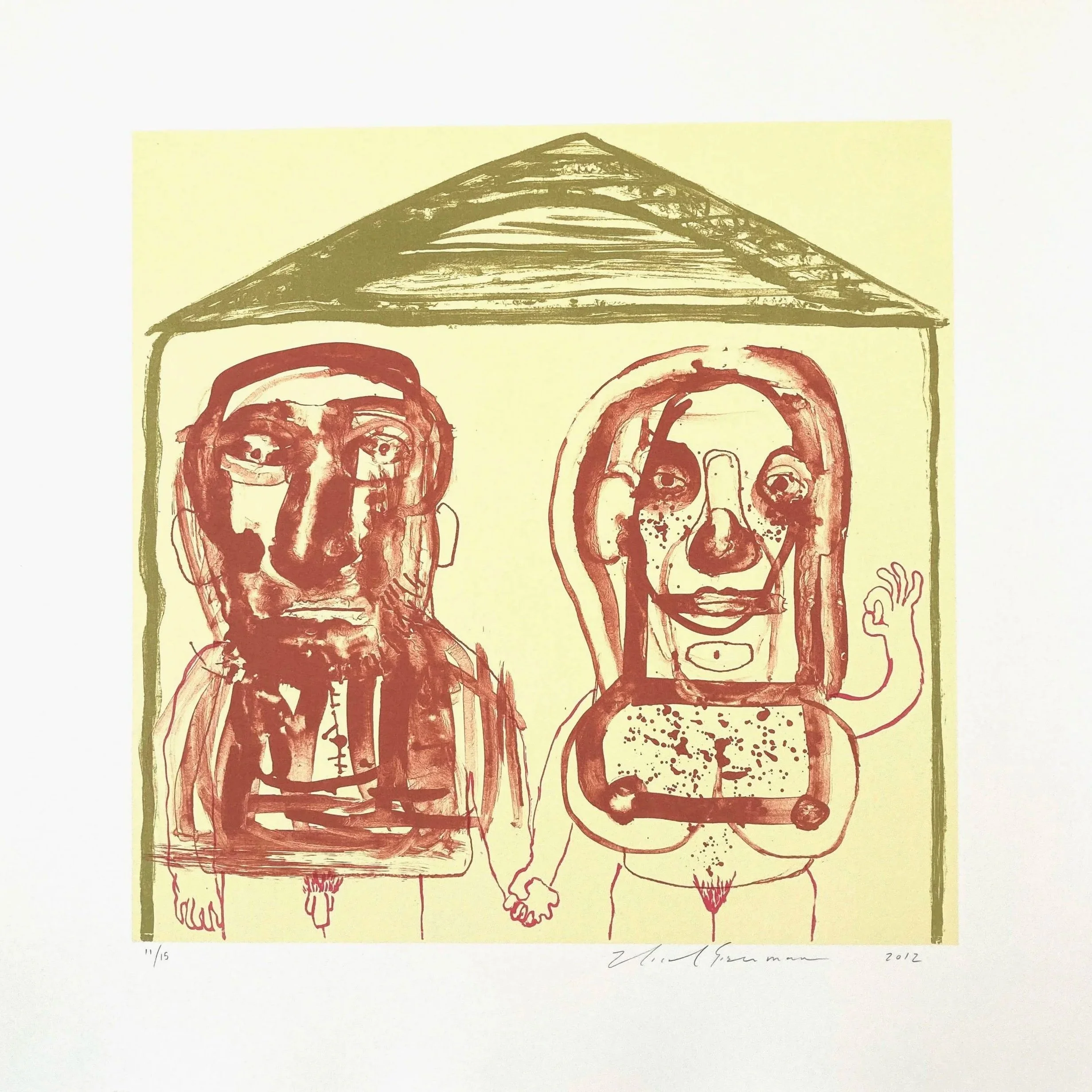
Harold and Medrie, 2012. Four-color lithograph on Somerset velvet. Paper Size: 21.5 x 22 in. Image Size: 16.25 x 16.25 in. Edition of 15.

Sloppy Bar Room Kiss, 2011. Lithograph. Paper Size: 18 x 17.75 in. Image Size: 12.75 x 13 in. NFS

Thinker, 2012. Six-color lithograph on Somerset velvet. Paper Size: 25 x 33.25 in. Image Size: 17.5 x 24.75 in. Edition of 25.

Dark Light, 2017. Two-color lithograph. Paper Size: 24.5 x 18 in. Image Size: 18 x 13.5 in. Edition of 20.

Drummer, 2011. Two-color lithograph. Paper Size: 22 x 16.75 in. Image Size: 16 x 11.625 in. Edition of 25.

Bouquet, 2018. Color lithograph. Paper Size: 25 x 20 in. Edition of 20. Published by FAWC. NFS

Conversation, 2012. Two-color lithograph on Somerset velvet soft white. Paper Size: 21.5 x 17.25 in. Image Size: 16.25 x 12 in. Edition of 25. NFS

Portrait of Evan, 2012. Lithograph. Paper Size: 21.75 x 17 .75 in. Image Size: 16.25 x 12 in. Edition of 9. NFS
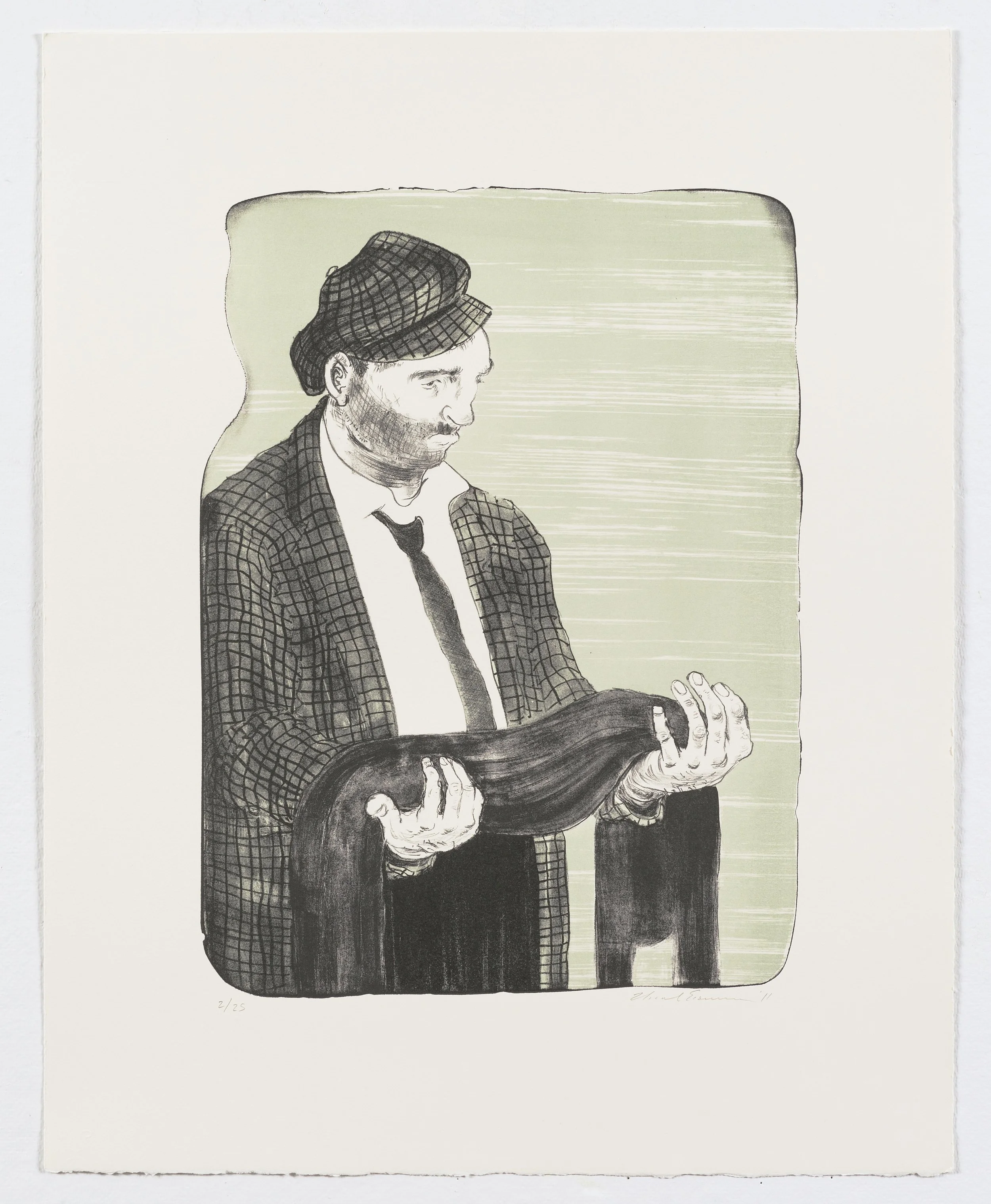
Man Holding His Shadow, 2011. Lithograph. Paper Size: 22.25 x 18in. Image Size: 16 x 12 in. Edition of 25. NFS
In the fall of 2009, I was teaching printmaking at Bard College, where I met Nicole Eisenman. They were teaching painting and sometimes we would share a ride back to New York.On one trip, we started talking about printmaking, and they said they had made a lot of monotypes on a press in their studio building in Gowanus Brooklyn. The press was set up in a small studio for resident artists to use for their own work. After I suggested we work on some prints at Jungle Press, Nicole invited me to their studio to look at current work. In their studio, I saw drawings everywhere, and paintings in progress: large cartoon-like heads, canvases with themes borrowed from the history of painting, like Pieter Bruegel’s “The Blind Leading the Blind”. The studio was packed with new work. I was bowled over, and asked Nicole when they wanted to start our print project.
Over the next few weeks ,Nicole came to Jungle Press and worked on etchings: images of a world-weary sailor, a family portrait, and a portrait a free-spirited artist looking like Picasso. Then they started working on their first lithograph, and drawing on the stone. They were quick to embrace the drawing materials–litho crayons and pencils and a variety of washes. And we began printing the results: “Sloppy Bar room Kiss”, “Man Holding his Shadow”, “Drummer”. On the largest stone, 43 x 33 in, they drew “Tea Party” a triple portrait of a “big boss” business man, aRevolutionary war figure in a tri-corner hat, and a skeleton all holding a grim-reaper sickle with the American flag. The figures are standing in a pool of water. It is an incredible scathing analysis of the political climate in 2009. Yet Nicole wanted more out of the image, and was looking for inspiration.
It was at this point that I suggested we visit the Metropolitan Museum of Art’s Print Study Room. A wonderful resource, the print study room is open to the public by appointment. Visitors write down which artist’s prints they would like to see, and the prints are retrieved from storage by their remarkable staff, along with extra prints they suggest. Nicole wanted to see Picasso and Munch, and I suggested some others, like Delacroix and Rudolph Bresdin. Picasso’s late prints, the “347 Suite” from 1969 resonated with Nicole. In this suite Picasso performs magic tricks with every etching technique, including one where he seems to mix oil and water together to create a turgid aquatint. “How did he do that?” Nicole asked. “I don’t know, but we can try it,” I said.
When we returned to the printshop, we agreed to try an oil wash over water for the background of “Tea Party.” We brushed water on the stone and Nicole brushed on the oily ink. The result was a watery oil slick-like surface, suggesting the dark and uncertain politics that had inspired the image. Over the next year and a half, Nicole returned almost every Tuesday to work on more prints. There were 16 editions made at Jungle Press during those months, and a wide variety of characters emerged on paper. Along with projects in etching (Harlan and Weaver) and woodcut/monoprint (10 Grand Press), an exhibition of Nicole’s nearly two years of exclusive devotion to printmaking was presented at Koenig and Clinton Gallery in New York in 2012. Later, the artist’s traveling retrospective “Dear Nemesis”, put together by CAM in St. Louis, showcased a large portion of Nicole’s printmaking output enabling an appreciation by a wider audience.
– Andrew Mockler
B. 1965, VERDUN, FRANCE
Nicole Eisenman’s work explores a broad range of human emotion with insight and humor. Delving into the highs and the lows of the psyche, they imagines a complex world where characters embrace love, melancholy, spirituality, appetite and desire.
Eisenman has shown widely in the U.S. and Europe, including at the Whitney Biennial, and is in the collections of the Museum of Modern Art, New York, NY; The Whitney Museum of American Art, New York, NY; Herbert F. Johnson Museum of Art, Ithaca, NY; The American Academy of Arts and Letters, New York, NY; San Francisco Museum of Modern Art, San Francisco, CA; Denver Art Museum, Denver, CO; Walker Art Center, Minneapolis, MN; The Ludwig Museum, Cologne, Germany.